
Why Primer is Mandatory in industrial inkjet printing?
Home>>Blog>>Application>>Why Primer is Mandatory in industrial inkjet printing?
The digital transformation of label printing is driven by shifting order structures: short-run jobs and multi-version orders keep growing, while lead times have been compressed from two weeks down to three days. The economic advantages of flexography in job changeovers and plate making have gradually eroded. It is within this market gap that inkjet technology has thrived: web speed has risen from 30 m/min to 70–100 m/min, resolution has been upgraded from 600 dpi to 1200 dpi, and white ink coverage has been improved from poor penetration to an 85% white ink printing rate.
Printing equipment has evolved dramatically, yet substrate compatibility has barely improved. Once the material scope expands beyond standard coated art paper to PET, BOPP, shrink films and even metallic paper, the equipment configuration will require a primer unit, or printers will simply switch to pre-primed substrates. New press specifications list the “Primer Unit (Optional)” as a standard option, which is now taken for granted across the industry.
There are three mainstream primer application methods:
- Pre-primed substrates: Substrate manufacturers apply an inkjet receptive primer coating during production. Printers receive ready-to-print materials without extra coating work. The downside is a 15%–30% higher cost per square metre, limited material specifications, and lead time dependency on raw material stock; production is held up if no inventory is available.
- Offline priming: A standalone coating machine handles priming and drying separately before the substrate enters the inkjet press. This method offers high flexibility, yet it adds an extra production step, extra material handling, and risks inconsistent batch quality. A coating thickness fluctuation of merely 0.1 μm can trigger colour density variations.
- Inline priming: Coating and drying modules are fully integrated into the inkjet press, enabling continuous operation: priming, drying, inkjet imaging and UV curing in one single pass. This configuration is widely adopted on high-end presses but carries the highest cost. Capital expenditure, energy consumption, drying capacity and speed matching all need to be engineered around the inline priming system. When web speed reaches 100 m/min, the heat transfer requirement and dryer length for primer drying become a rigid technical bottleneck that caps the overall press speed.
All three approaches follow the same engineering principle: a receptive surface tailored for inkjet must be formed on the substrate before ink droplets land.
For the same film substrates, flexographic printing can run at speeds above 100 m/min with only a corona treatment unit and properly formulated UV inks, without any primer coating. Offset printing on coated art paper requires no priming at all. For an identical substrate, priming becomes unnecessary simply by switching printing technologies. The root cause of priming demand lies intrinsically within inkjet technology itself.
The physical functions of the primer coating fall into four core categories:
- Adjust surface energy to ensure ink spreading without wetting. Untreated polyolefin films such as PP and BOPP only have a surface energy of 28–30 mN/m (dyn/cm, equivalent numerical value), lower than the surface tension (28–38 mN/m) of most UV inkjet inks. Ink droplets contract into spherical wet with a contact angle greater than 90°. The primer raises substrate surface energy to 38 mN/m or higher to meet wetting requirements.
- Provide polar groups or chemical bonding sites to secure ink adhesion. Corona treatment can also introduce polar groups, yet primers can embed reactive sites within the coating layer to form stronger hydrogen bonds or covalent cross-linking with resins and monomers in the ink layer.
- Control ink absorption kinetics to separate water, monomers and pigments at the right timing. Water-based inks require substrate water absorption to fix pigments; UV inkjet systems, by contrast, must prevent excessive monomer penetration into the substrate, which causes sticky surface finish and weak adhesion. The primer acts as a precisely controlled filter layer.
- Restrict dot gain and ink feathering, establishing a controlled spreading boundary for ink droplets. Inkjet delivers direct droplet deposition without the confinement of printing plates or blankets. Once 2 pL micro-droplets spread unevenly across areas with inconsistent surface energy, printed edges turn blurred.
All four functions serve one single purpose: compensating for inkjet’s inherent poor substrate adaptability.
Primer application brings four major costs and drawbacks:
- Cost burden: Primers are priced by volume or area. Capital depreciation for coating equipment plus energy consumption for drying are ultimately allocated to per-metre label production costs. Pre-primed films cost significantly more than standard films; inline coating units account for a substantial share of the total press quotation.
- Speed limitation: The primer layer must be fully dried immediately after coating. At 70 m/min web speed, only a fraction of a second elapses between ink deposition and main UV curing. The primer drying process must evaporate solvents or moisture within this tight time window, making thermal load and oven length the primary bottleneck limiting line speed.
- Increased failure modes: Every new interface introduces extra process variables: coating thickness uniformity, cross-linking degree, drying completeness, substrate matching, shelf life and batch variation. The original two-variable matching (ink + substrate) expands into a three-variable system (ink + primer + substrate). Defects arising from incompatibility between any two components result in waste, with liability hard to assign. Materials treated via offline priming suffer a 5 mN/m drop in surface energy after two weeks of storage, leading to inconsistent print quality between freshly coated and aged stock, which is extremely difficult to diagnose.
- Masking underlying technical flaws: With primer coating in place, the press delivers flawless print results, yet it becomes impossible to distinguish how much quality comes from the inkjet system and how much comes from the primer’s fault tolerance. Degraded printhead performance, flawed ink formulation and insufficient curing energy can all be masked by the coating’s forgiving properties. Once printers switch to non-primed substrates or customers demand primer removal to cut costs, all hidden defects surface at once.
For substrates with extremely low surface energy, such as siliconised release liners, metallic paper, and porous papers with unpredictable absorption behaviour, the physical mismatch between inkjet inks and these materials is too severe. Applying a functional interfacial coating is a rational engineering solution.
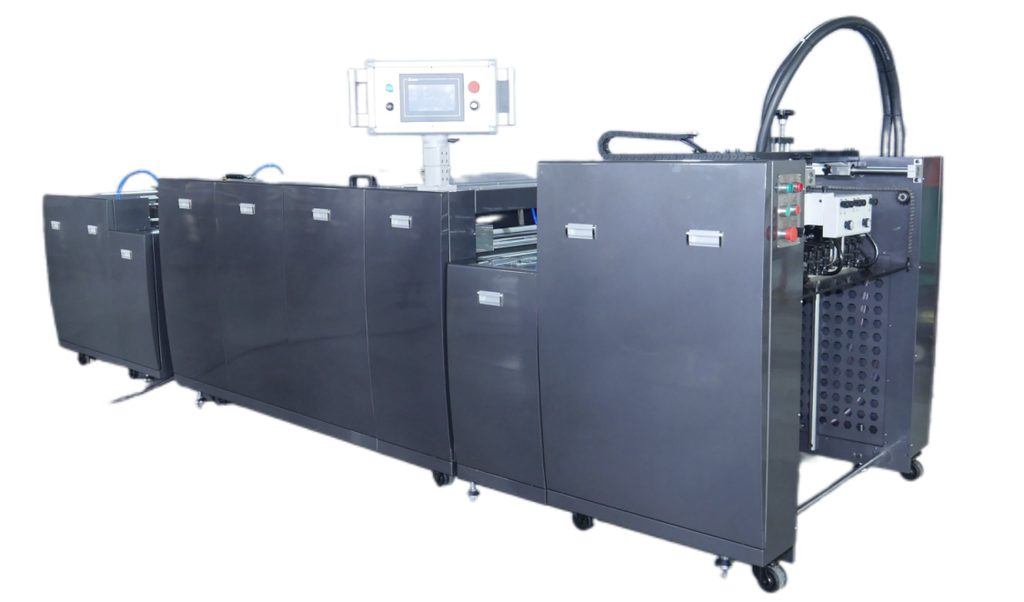
We are professional supplier of primer coating machine in printing industry and we provide different primer coating solution for different primer types.
About Newbinder:
Wuxi Newbinder Technology Co., Ltd is a professional Import & Export BPO Service provider for Printing & Packaging machines industry.
We mainly export and supply Flood UV & AQ Coating Machine, Inkjet Spot UV Coater with Digital Foil, Automatic Die Cutting and Creasing Machine, Automatic Hot Stamping and Embossing Machine etc.
Wuxi Newbinder Technology Co., Ltd
Room 1715, Buynow Technology Tower, Wuxi Jiangsu 214031
Tel.: 0086-510-85861234
Web: www.newbinder.com
Email: sales@newbinder.com
Cellphone: 0086-13306180351
Whatsapp/wechat: 0086-18801816271